
Two years is but a blip in the history of our planet. The Rainmatter Foundation is past the two-year mark. That day came and went, and we were unsure if we ought to make an announcement or do something special.
“What’s there to celebrate? An entire Himalayan town has been sinking, there’s been only one snow day in Shimla throughout this winter and there were floods in California and Auckland. There is nothing to suggest that 2023 will be better,” Sameer would say.
“That’s too much gloom-and-doom. We must be hopeful!” I’d likely retort.
It’s been that kind of a journey. Ups, downs, questions, debates, discussions, more questions, and very few answers. One of the reasons we missed the ‘anniversary’ is because we are in the midst of a deep, long relook at our processes, our partnerships, our investments, our thesis – everything. We stepped back and took a pause.
When we started out in January 2021, we had full pockets, a lot of goodwill, some very generous volunteers, a CEO and a fuzzy map for multiple directions. We were in the spotlight. We had to start “moving the needles,” as Sameer often puts it. But what precisely are the needles and where does the ‘doing’ really begin?
Should we be funding technological innovations that might possibly make trees grow faster, or magical engineering for carbon capture? Would more EVs be better for urban ecology and is human intervention in the wilderness meaningful for forest health? What could we really do with all the waste that we generate? Should we be looking at environmental legislation or focus on making ecological data available to all? Do we back individual heroes who’ve set up seed banks and restored ponds, or do we support calls for industry to cap growth? Do we commit resources to organisations with large farmer networks or pour money into research? More importantly, how do we narrate and share learnings and best-practises, and move towards more environmentally-sensitive behaviour?
We did not have many answers, and we were also unsure if these were the right questions to start with. After all, where does the climate crisis begin? Does it start when we use fertilisers and irrigation for higher crop yield needed to feed millions? Does it start when we trade-off jowar rotis for rice dosas and quinoa salads? Or does it start when the beehives and birds disappear after trees are logged for four-lane highways? Or perhaps it starts when our brain-function surrenders to the 70% online sale or when we are unable to tell the difference between the convenience of plastic packaging and the cost to the environment. Much depends on who we put the question to.
So we started by doing a bit of everything. Aware that there is no one-size-fits-all solution, we adopted a loose framework; questions around community-stake and involvement, long-term resilience versus project outcomes, potential and ability to scale and sustain, collaborator mindset, open-access principles, solutions that plugged gaps such as in market connects and policy or broke barriers to data and information. These aspects tethered our approach and decision-making. Much of what we did in the early months can be characterised as throwing “darts-in-the-dark” or supporting “good-people-doing-good-work”. This was partly because of the above-mentioned challenges and partly due to circumstantial constraints; Many in the team and at Zerodha were responding to the urgent needs that the Covid wave brought with it across the country.
In the break between the pandemic waves, we started to travel to meet people and practitioners; some had been in the field for decades. We observed. We asked questions. We listened. We had our myths dispelled (a cloth bag is good for the planet only if we use it for at least three years, else it leads to additional textile waste), beliefs challenged (what is knowledge and insight, and who has access to these, what are the missing resources) and opinions changed (around how gender and caste issues intersect with climate). This learning came from partner organisations as well as from organisations that reached out for funding support. We have also been fortunate to hear from other funders their outlook and methodology not just to grant-making but more critically to understand how to start effecting change at scale.
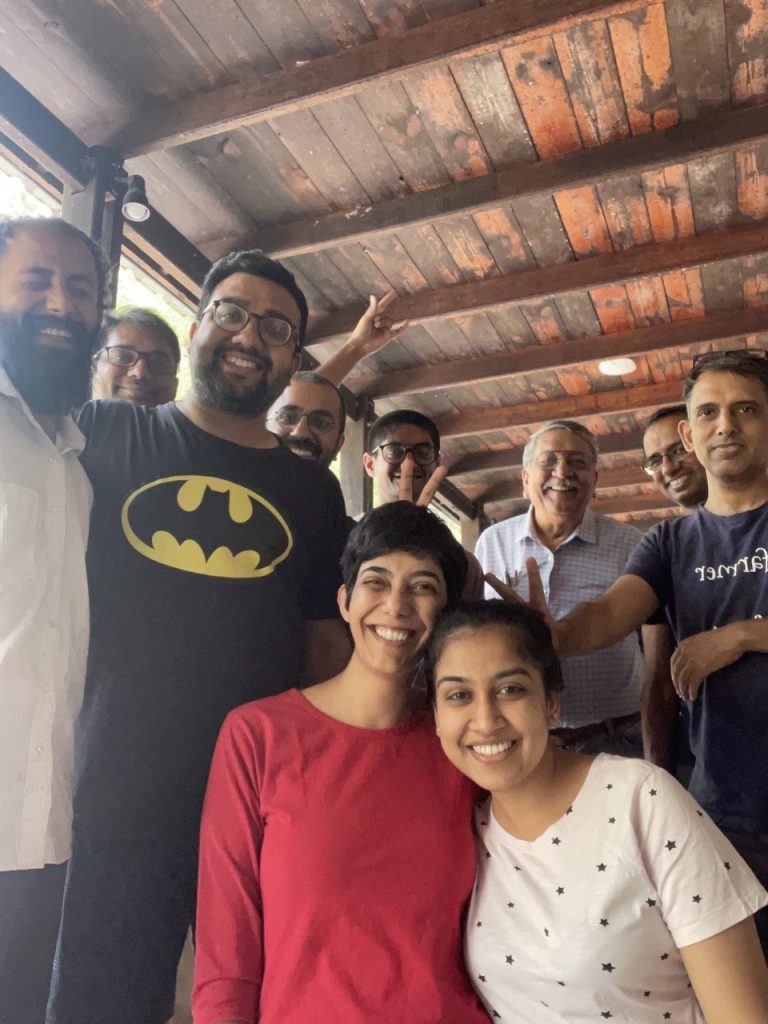
By the end of 2021, the Rainmatter Foundation had committed about Rs75 crore to 27 organisations whose efforts ranged from conservation research and practise (Centre for Wildlife Studies, Nature Conservation Foundation, Dakshin, Centre for Social and Environmental Innovation) to policy framing and advocacy (Vidhi Legal, Janaagraha, CSTEP, Fields of View) and from community waste management (Waste Warriors) to restoration via plantation or payment-for-ecosystem services (SayTrees, Farmers for Forests). We had also sprouted a team: Divya was borrowed from Zerodha, and Santhosh (farm systems), Ganeshram (ecological wealth and biodiversity), Akshay (technology fellow), Marisha (narratives and outreach), Rishabh Lalani (the social network & change-makers), Varun (EBTL) and Rishabh Verma (data as commons) came onboard. Vikas (food and farm systems & waste), Abhishek (playbooks) and Tanmayi (communications and outreach) have since joined the team. Santhosh and Akshay have moved on to find their own niche. The bracketed labels are inadequate, and fail to encompass all that this team has been doing.. and sometimes fails to do; they are (or were) all here because they are passionate folks who care about something beyond just a “job”, and because of a common belief around the need to solve the biggest crisis the planet has ever faced, and around the pathways to them that matter to communities, their places and their commons.
It was in 2022 that we were able to arrive at a lens for looking at the environment and the climate challenge in a slightly more holistic manner. This was not the proverbial “the-apple-dropped” moment. It came from a distillation of hundreds of conversations and anecdotes, practices, information and lived-knowledge from dozens of people and partner organisations over a period of several months. For instance, people in a vand (small hamlet) in the Little Rann of Kutch told us they were procuring much of their food and household supplies from the city i.e. from Morbi; that the fields were not being tilled because the men now worked in the Ceramic City’s factories (Morbi produces 90% of the country’s ceramic products); that the port expansions along the coast was making their soil more saline. Degraded lands, disappearing biodiversity, stressed agriculture, manufacturing-centric livelihoods and emissions and the lengthening of food supply-chains is the thread that stitches much of India’s environmental distress, leading to migration and consequently urban chaos. “But what about the place,” someone asked us in another conversation in another part of the country, referring to the place of departure.
One approach we feel strongly about, and for which we are seeking critical feedback, is place-based. The climate crisis is a place problem. We experience it differently in different places. As erosion and declining fish stock in coastal areas, as severe heat in the hinterlands, as glacial-melt and flooding in the mountains. The response to it must therefore be rooted in the local context and needs. There are limitations to this lens, and we are open to explore and engage on this with others; do reach out ([email protected]) if you can navigate this with us.
We are trying to make sense of all the work we’ve supported so far with this approach. The hope is that with these core principles and some long shots, the right responses will start to emerge if we keep doing the right things for the right reasons in the right directions. And make a habit out of periodic introspection. As of January 2023, we have nearly 65 organisations and committed individuals doing amazing things on the ground. They are working with communities to co-imagine and bring change, crafting solutions that can help with solving problems, engaging in research and ideas that can inform solutions, and supporting policy and governance to become sharper tools for climate positive change.
Another 2022 milestone has been the constitution of a Board of Directors. This Board is enabling us to refine our processes, streamline our operations and strengthen our organisational structure. We’ve slowed down to pause and put the house in order.
We owe much gratitude to multiple individuals and dozens of organisations who’ve shared perspectives and insights, bounced ideas with us, guided us or walked with us through situations we did not fully comprehend or pushed us to do more/do better. Thank you, for enabling us to walk this far. There’s a long way to go to help undo the planetary damage, and we request you to keep giving us your love as we take baby steps in this journey.